
The Mythology Behind Prasad: Why Each Temple's Sacred Food Carries a Different Divine Blessing
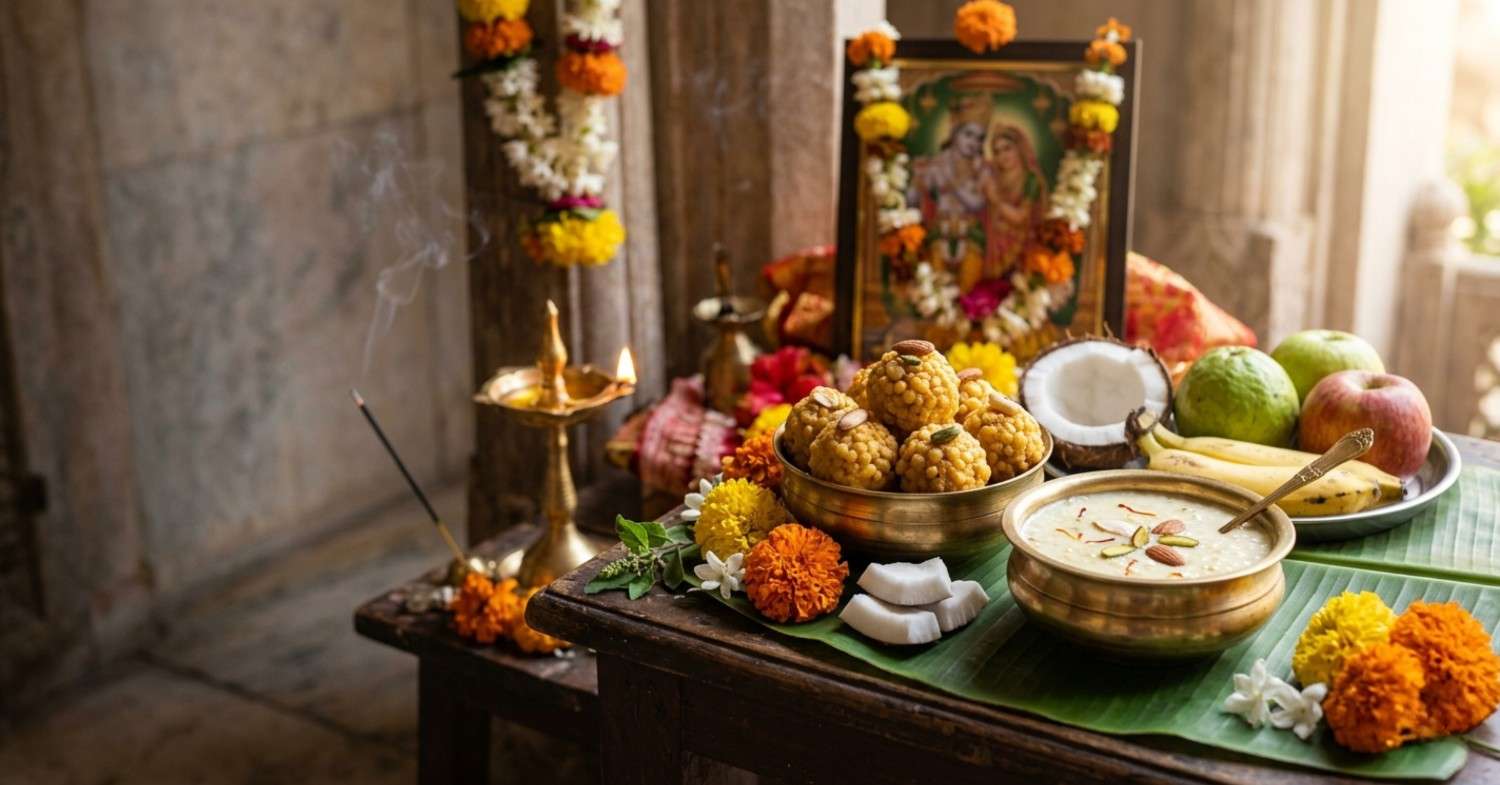
Prasad is more than temple food, it’s a quiet exchange between you and the divine. From Jagannath’s khichdi to Ganesha’s modak and Sai Baba’s sacred ash, every offering carries a story, a belief, and a specific blessing shaped by mythology and devotion. What you receive isn’t just food, but grace infused with intention, purity, and centuries of faith. Each temple’s prasad reflects the nature of its deity, turning a simple ritual into something deeply personal and spiritual. When you accept it with awareness, you’re not just taking a bite, you’re becoming part of a timeless connection that transcends generations.
Every time you cup your hands to receive prasad at a temple, you are not simply accepting food. You are completing a conversation that began thousands of years ago between a devotee and their deity.
Most people receive prasad out of habit, a reflex built into every temple visit since childhood. You stand in line, hold out your hands, place it on your tongue and move on. But very few pause to ask why Jagannath Puri offers khichdi while Ganesha temples offer modak, why Shirdi hands out sacred ash instead of sweets, or why Shiva temples in certain regions offer thandai and milk. These differences are not regional accidents or culinary preferences. Each one is rooted in specific mythology, Puranic scripture and the unique spiritual energy of the presiding deity.
Understanding what is prasad in Hinduism at this deeper level does not complicate the ritual. It transforms it. A passive act of receiving becomes a conscious, living connection with centuries of devotion, divine story and spiritual wisdom.
More Than Blessed Food: The Divine Exchange Behind Every Offering
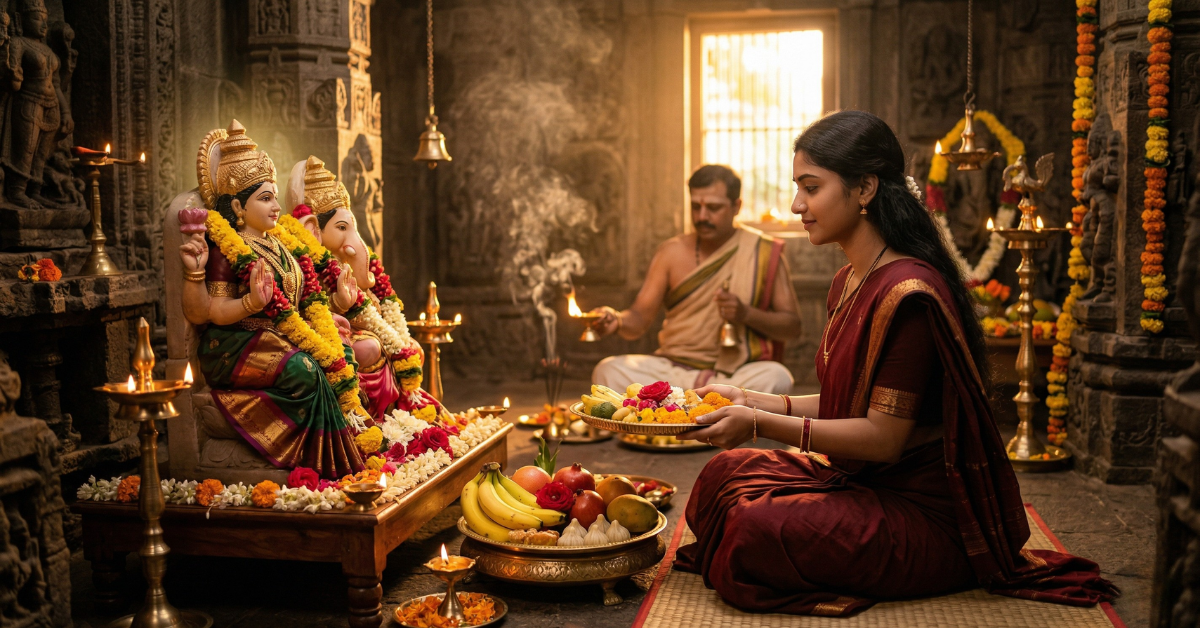
The word prasad carries its meaning in its roots. Derived from Sanskrit, it points to grace that flows downward from the divine to the devotee, something that purifies and settles the mind completely.
But one misconception needs clearing first.
The offering is not made to the idol. The idol is a focal point, a physical anchor for something that has no physical form. God, in Hindu understanding, is the infinite divine consciousness that permeates everything. The physical offering at the idol’s feet is simply the gesture. The actual offering reaches that all-pervading consciousness.
When divine consciousness accepts an offering, what returns is the same food charged with something new: divine energy specific to that deity, specific to that moment of genuine offering.
The Bhagavad Gita captures this simply. Krishna says he accepts whatever is offered with love, whether a leaf, a flower, fruit or water. The material value is irrelevant. Sincerity is everything.
This is why prasad must be satvik in preparation. Clean ingredients, a calm state of mind during cooking and the avoidance of tamasic ingredients like onions and garlic are not arbitrary rules. They preserve the energetic purity of the offering so that what returns to the devotee carries the highest possible quality.
Think of it the way a farmer thinks about seeds. What you put into the earth determines what comes back. The devotee offers love, devotion and purity, and receives blessing, grace and divine energy in return. That is prasad at its most essential level.
The Mythology Behind India's Most Sacred Temple Prasads
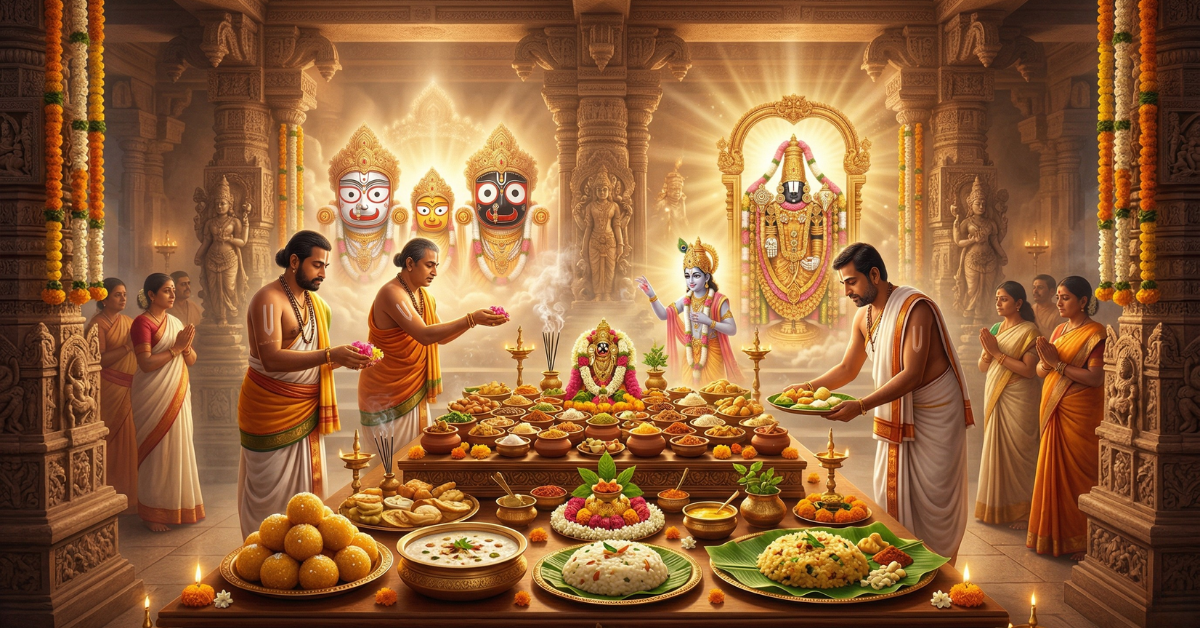
1. Jagannath Puri: Where Goddess Lakshmi Cooks
The Mahaprasad of Jagannath Puri is in a category of its own. The temple kitchen in Puri is one of the largest in the world, preparing food daily for tens of thousands of devotees using traditional earthen pots stacked one on top of another over open fires. What makes this extraordinary is not the scale but something that has puzzled observers for centuries: the topmost pot cooks first, not the bottom one. Every attempt to explain this through ordinary physics falls short.
Tradition offers its own explanation. Goddess Lakshmi herself oversees every preparation in that kitchen. Her presence ensures not just that the food is cooked but that it is sanctified at a level no human hand alone could achieve.
The Skanda Purana describes Jagannath’s Mahaprasad as Brahma Padartha, a substance of the highest divine order. Consuming it is said to dissolve accumulated karma across lifetimes. But perhaps the most powerful aspect of this prasad is what happens when it is distributed. Kings and commoners, priests and pilgrims, the wealthy and the destitute all eat the same food from the same kitchen. Caste distinctions, social hierarchies and economic differences dissolve completely in that act. The Mahaprasad does not just nourish the individual. It enacts a living theology of spiritual equality every single day.
2. Ganesh Temples: The Honey of Knowledge in Every Modak
The story behind Ganesha’s modak comes from one of Hinduism’s most charming mythological episodes. Kubera, the god of wealth, once invited all the gods to a grand feast to display his abundance. Every deity ate extravagantly, yet somehow remained unsatisfied. Ganesha alone, offered a humble moya, a simple puffed rice sweet, found complete contentment and fulfillment.
This moment established something important in the devotional tradition. Genuine spiritual satisfaction does not come from spectacle or abundance. It comes from the right offering, made with the right intention, at the right time.
The modak’s shape carries its own theology. Its conical form represents Mount Meru, the cosmic axis at the center of Hindu cosmology. Its sweet interior represents Jnana, the nectar of inner knowledge. When you receive modak as prasad at a Ganesha temple, you are not just receiving a sweet. You are receiving a reminder that wisdom and the removal of obstacles come from simplicity and sincerity, not from how elaborate your offering appears.
3. Shirdi Sai Baba: Sacred Ash That Heals
Throughout his life at Dwarkamai in Shirdi, Sai Baba maintained a dhuni, a sacred fire that burned continuously without interruption. The ash from this fire, which Baba called Udi, became his most powerful tool of healing. He distributed it to the sick, the grieving, the fearful and the lost. Countless testimonies record remarkable healings and protections attributed to this sacred ash.
The Udi carries a teaching that sits at the heart of Vedantic philosophy. The body is temporary, it will return to ash. The soul it houses is eternal and beyond all suffering. Receiving Udi as prasad is an act of consciously accepting this truth rather than fearing it.
When Udi is applied to the forehead, it is traditionally placed at the location of the Ajna chakra, the third eye, the center of spiritual perception and intuitive wisdom. The blessing is not placed randomly. It is directed precisely where spiritual awareness resides. That is not a coincidence. That is the living intelligence of a tradition that understood the human energy system with extraordinary precision.
4. Shani Shingnapur: Pacifying the Planet of Karma
Lord Shani is perhaps the most feared deity in the Hindu pantheon, and almost always the most misunderstood. He is not a deity of punishment. He is the deity of karma, discipline and the precise consequence of action. His gaze reveals what you have earned, not what he has decided to inflict.
The prasad offered at Shani Shingnapur, rooted in the ancient Navagraha tradition, uses oil and sesame seeds because these specific materials are associated with Saturn’s pacification in Vedic astrology. The offering is an acknowledgment: I understand that my actions have consequences, and I approach those consequences with awareness and humility rather than resistance and fear.
Receiving this prasad carries a uniquely mature spiritual lesson. It does not ask you to escape karma. It asks you to face it consciously. That shift from avoidance to awareness is precisely what Shani’s tradition teaches, and it is encoded into every drop of oil offered at his shrine.
5. Vaishno Devi: Purity in Simplicity
The Goddess who resides in the Trikuta Mountains of Jammu does not ask for elaborate ritual or expensive offerings. Her prasad of puffed rice and dry fruits is a direct reflection of her own nature: raw, unadorned and powerful in its absolute simplicity.
There is a profound theological statement in this simplicity. The Shakta tradition understands the divine feminine as primal energy, Shakti in her most essential form. She does not need embellishment. She does not require the devotee to arrive with gold or expensive sweets. She requires a pure heart and sincere intention. The mountain journey to reach her shrine reinforces exactly this teaching. The physical effort of the pilgrimage strips away comfort and pretense. By the time the devotee arrives, what remains is genuine.
Receiving puffed rice and dry fruits at Vaishno Devi is receiving the Goddess’s own statement about what she values in her devotees.
6. Shiva Temples: Detachment in Every Sip
Shiva’s prasad is the most philosophically layered of all. As the Mahayogi and Adiyogi, the first yogi and the embodiment of supreme renunciation, Shiva’s association with bhang, milk and thandai is not a glorification of intoxication. It is a symbolic representation of a state of consciousness that lies entirely beyond ordinary sensory experience.
The cooling nature of milk and thandai connects directly to the tradition of Abhishekam, the sacred bath offered to the Shivling. The Shivling represents Shiva’s fierce cosmic energy in its concentrated form. Cooling offerings pacify that intensity and invoke his benevolent, accessible aspect. When a devotee receives milk or thandai as prasad from a Shiva temple, the blessing being transmitted is the capacity for inner stillness, the ability to remain centered, calm and unshaken regardless of what the external world is doing.
That is Shiva’s greatest gift to his devotees. Not miracles or material blessings, but the unshakeable equanimity of the Mahayogi himself.
What Happens to Food When It Is Offered With Devotion?
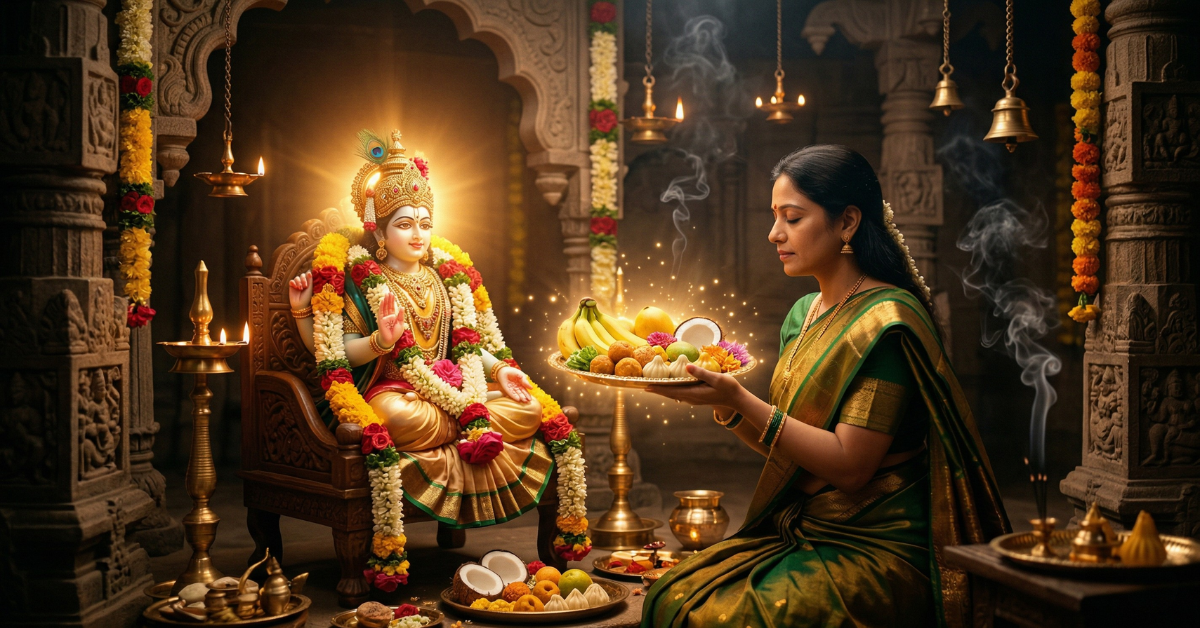
The transformation of ordinary food into prasad is not purely symbolic. The combination of clean satvik ingredients, focused devotional preparation, ritual consecration and collective sincere intent creates measurable energetic shifts in the offering.
Modern research on the relationship between conscious intention and physical matter has begun exploring what ancient traditions understood intuitively: that focused positive intention directed at a physical substance changes its energetic quality. The collective devotion of thousands of worshippers gathered at a temple, all directing sincere prayer toward a single sacred space, creates a concentrated positive electromagnetic field that the prasad absorbs.
The act of samarpan, formal offering, charges the food with the specific vibrational energy corresponding to the presiding deity. This is why the prasad of a Ganesha temple feels different from the prasad of a Shiva temple, not just in taste but in the subtle quality of what it carries. And when that prasad is distributed equally to everyone present, the spiritual and social benefits multiply. Community, equality, shared grace and collective upliftment happen simultaneously in that single act of distribution.
Receiving and Offering Prasad With Full Awareness
The way prasad is received matters as much as the offering itself. Cup both hands open and upward, never receive with one hand or casually. Accept it with genuine gratitude, recognizing it consciously as divine grace rather than a temple formality. Consume it immediately if possible rather than pocketing it and forgetting. Never waste prasad. If you cannot consume it, share it with others or offer it to animals respectfully.
When preparing prasad at home for puja, the same principles apply. Use clean and satvik ingredients. Cook with a genuinely calm and positive state of mind. Avoid onions, garlic and other tamasic ingredients. Offer before consuming. The intention behind the preparation is not a secondary concern. It is the primary one. The Bhagavad Gita is clear: what reaches the divine is the love behind the offering, not the offering itself.
Is an Online Puja as Spiritually Valid as an In-Person One?
This question deserves a direct answer because it is the one that sits beneath every other concern about e puja India.
The skeptic’s argument is that physical presence at a ritual carries an irreplaceable quality, an immersive, multisensory experience that a screen cannot replicate. This is true as an experiential observation. A live, in-person ceremony at a major temple in India is an extraordinary thing to be part of.
But spiritual validity and experiential richness are two different things. The Vedic tradition is unambiguous about where a ritual’s power resides: in the pandit’s qualifications, the correct performance of prescribed procedures and the sincerity of the devotee’s sankalpa. All three are fully present in a properly conducted online puja.
The tradition of proxy rituals, performing ceremonies on behalf of absent devotees, is not a modern accommodation. It predates technology by centuries. Families have always had rituals performed at Kashi or Prayagraj or Tirupati on behalf of members who could not be there. What Temple Dekho offers is the same principle extended and made accessible to a global community through live-streaming technology that allows the devotee to be present in real time rather than simply represented.
The divine has never required a passport. Sincere devotion, properly guided by qualified ritual expertise, has always been sufficient.
Conclusion
Every temple’s prasad is a mythology made edible. It is a story compressed into a taste, a scripture encoded into a sweet, a theological statement delivered through the simple act of placing something sacred in an open pair of hands.
The significance of prasad in Hinduism is not that the food is magical. It is that the exchange is real. Devotion offered sincerely returns as grace received genuinely. The diversity of temple prasad across India is not religious complexity to be simplified. It is spiritual richness to be understood and celebrated.
When you receive prasad with awareness, you are not just accepting food. You are accepting a story, a blessing and a living thread of connection to the divine that has been passed from hand to hand across generations for thousands of years.
Can’t visit the temple in person? Temple Dekho lets you book an online puja so the prasad and the blessing still find their way to you, wherever you are.