
Puja in the Digital Age: How NRIs and Overseas Indians Are Staying Connected to Their Roots Through Online Rituals
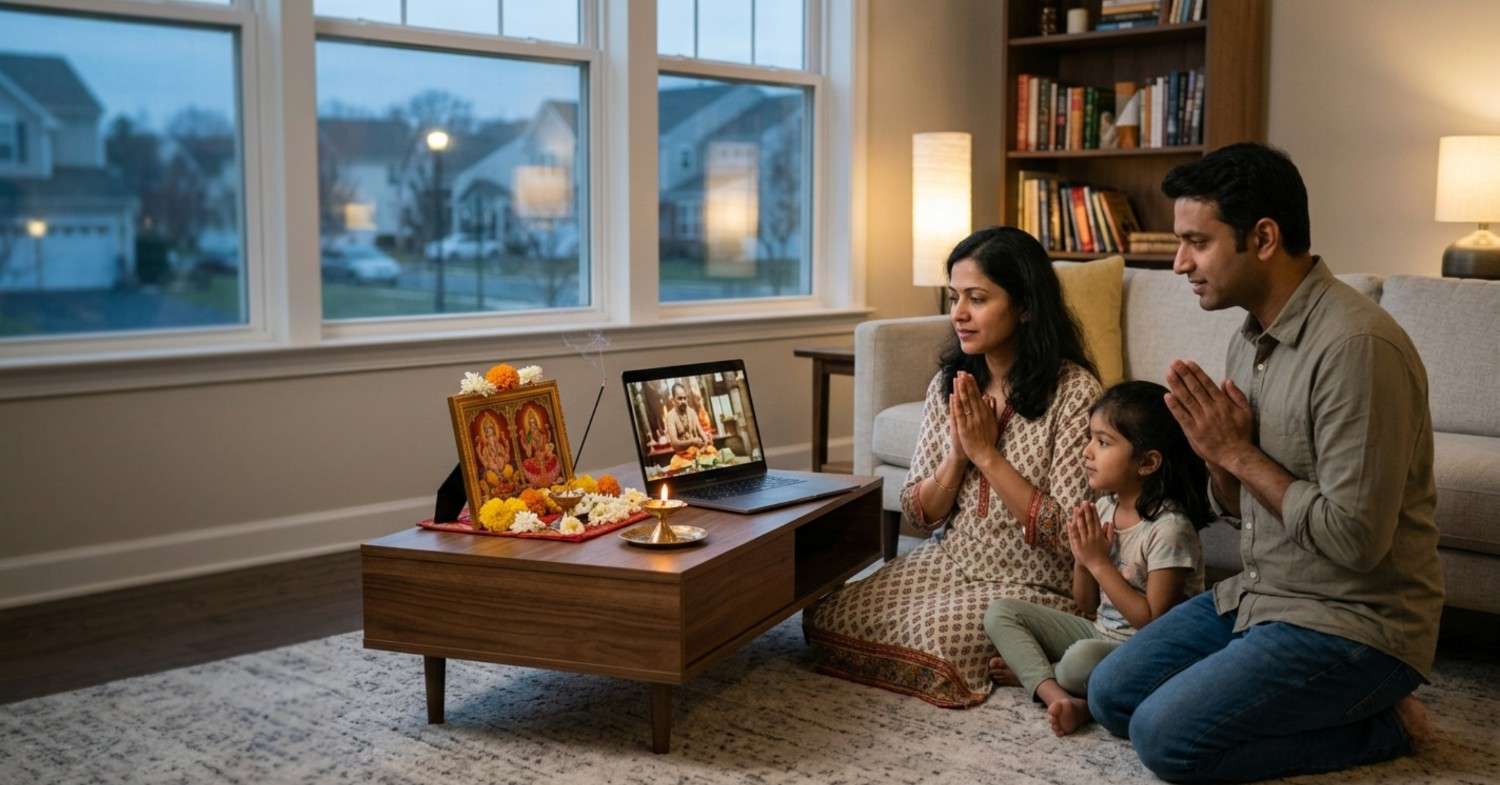
For Indians living abroad, staying connected to faith no longer depends on distance. Online puja services have made it possible to take part in authentic rituals from anywhere, whether it’s a small apartment in London or a home in Dubai. With verified pandits, live-streamed ceremonies and personalized sankalpa, these rituals carry the same spiritual depth as those performed in India. More than convenience, it’s about preserving identity, celebrating life’s milestones and passing traditions to the next generation. In a world spread across continents, devotion hasn’t weakened, it has simply found a new path, proving that faith can travel wherever you go.
Thousands of miles from home, on a Tuesday evening in Dallas or Dubai, an Indian family gathers around a laptop screen. In India, a pandit lights the lamp, the fragrance of incense fills the room and the mantra begins. The family folds their hands. The puja has started.
This scene is playing out in living rooms across the United States, United Kingdom, Canada, Australia and the Gulf every single day. For millions of NRIs and overseas Indians, the distance from India has never meant distance from faith. But the practical realities of that distance, the time zones, the absence of nearby temples, the lack of family elders to guide ritual practice and the sheer impossibility of flying back to India for every significant occasion, created genuine gaps in religious observance that no amount of devotion alone could bridge.
Online puja services India has stepped into exactly that gap. Not by replacing the ritual or diminishing it, but by extending it across borders through technology that has finally caught up with what devotion always demanded: a way to stay connected regardless of where life has taken you.
This is not the dilution of tradition. It is its continuation, carried forward by devotion and delivered through technology.
What Happens Inside You When You Chant?
Before exploring how these services work, it helps to understand something fundamental about the spiritual tradition they are built on.
The Bhagavad Gita contains one of the most quietly powerful statements in all of Hindu scripture. Krishna tells Arjuna that he accepts whatever is offered with genuine love, whether a leaf, a flower, fruit or water. The material value of the offering is irrelevant. What reaches the divine is the sincerity behind it.
This principle is not a modern reinterpretation made to accommodate digital convenience. It is the foundation on which the entire tradition of puja rests. A ritual’s power comes from three sources: the qualifications and intention of the priest performing it, the correct execution of prescribed Vedic procedures and the sincerity of the devotee’s sankalpa, the formal statement of name, lineage and intention that opens every ceremony. None of these three require the devotee to be physically present in India.
In fact, the tradition of proxy rituals, ceremonies performed on behalf of someone who cannot attend in person, is ancient and well-established in Vedic practice. Pilgrims have long had rituals performed at sacred sites on their behalf. The elderly, the ill and those unable to travel have always been included in ceremonies through proper representation. What technology has done is not create something new. It has extended something old to a scale that was previously impossible.
For second-generation NRIs growing up in foreign countries, this matters in a particular way. Cultural identity does not transmit through books or explanations alone. It transmits through experience, through watching a lamp being lit, through hearing mantras chanted in Sanskrit, through the smell of incense and the sight of prasad being distributed. Virtual puja for NRIs creates exactly these experiential memories for children who might otherwise grow up entirely disconnected from the living practice of their heritage.
More Than a Screen: What a Genuine E-Puja Experience Actually Includes
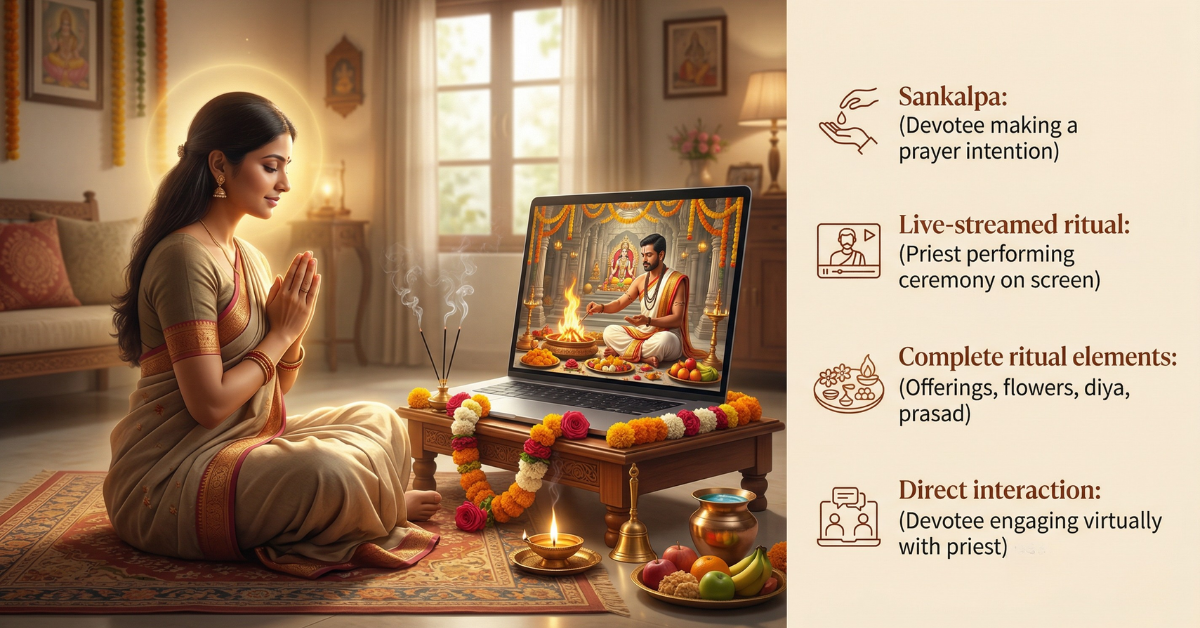
One of the most common misconceptions about e-puja is that it amounts to watching a pre-recorded video of a ceremony. The reality is considerably more substantial.
What a Properly Conducted Online Puja Includes
- Sankalpa: The ceremony begins with the pandit reciting the devotee’s full name, gotra and specific intention. This is the moment the devotee’s identity and purpose are formally placed before the divine. When a pandit in Varanasi, Tirupati or Vrindavan recites your name and lineage, you are present in that ceremony in the most spiritually meaningful sense.
- Live-streamed ritual: Conducted in real time by a qualified pandit following authentic Vedic procedures, with mantras chanted correctly in Sanskrit.
- Complete ritual elements: The fire, offerings, aarti and specific prayers corresponding to the ceremony’s purpose are all performed as they would be in person.
- Direct interaction: Most platforms allow devotees to ask questions, offer specific intentions and receive guidance from the pandit during the ceremony.
What Temple Dekho Specifically Offers
- Verified pandits whose Vedic knowledge and ritual accuracy have been confirmed.
- Full personalization based on the devotee’s specific details, family traditions and regional customs.
- Virtual darshan at major temples across India with access to darshan schedules and festival timings.
- Panchang-based Muhurat recommendations ensure every ritual is scheduled in a genuinely auspicious window.
- Time zone coordination so that the ideal Muhurat in Indian Standard Time aligns as closely as possible with a workable time for the devotee abroad.
Four Reasons NRIs Are Choosing Virtual Puja: The Real Motivations
The shift toward online puja services is sometimes described as a matter of convenience. That is true but incomplete. The real motivations run deeper than scheduling ease.
- Authenticity is the first and most important one. The single most common concern NRIs raise about online rituals is whether they carry the same spiritual validity as in-person ceremonies. This concern comes from a genuine and admirable place: a deep respect for the integrity of the tradition. The answer, as established above, lies in understanding where a ritual’s power actually resides. It resides in the pandit’s qualifications, the correct performance of procedures and the devotee’s sincere sankalpa. Temple Dekho addresses this directly by verifying every pandit on the platform and ensuring every ceremony follows authentic Vedic protocol.
- Cultural continuity for the next generation is the second. A parent who performs an online Satyanarayan Puja with their children present at the screen is doing something far more significant than observing a personal religious practice. They are creating an experiential memory in their child’s mind that connects ritual, family and divine presence in a single moment. Children who grow up witnessing these ceremonies, even through a screen, carry a fundamentally different relationship to their heritage than those who only hear about it secondhand.
- Honoring life’s milestones properly is the third. Birth, naming, marriage, housewarming, ancestral rites: these are not optional observances for most Hindu families. They are the spiritual architecture of a life lived in accordance with dharma. When an NRI family cannot travel to India for a naming ceremony eleven days after a child’s birth, or when a new home in Toronto needs a proper Griha Pravesh before the family moves in, virtual puja for NRIs ensures the milestone is honored with the full weight of Vedic tradition regardless of which continent it happens on.
- Staying spiritually grounded in a foreign environment is the fourth. Living in a country without nearby Hindu temples, without the seasonal rhythm of Indian festivals filling the streets, without family elders carrying the living memory of how things are done, creates a kind of spiritual hunger that is difficult to describe to someone who has not experienced it. Online puja services India provides a consistent, reliable way to feed that hunger. Not just at Diwali and Navratri but in the small, regular observances, the monthly Satyanarayan, the Ekadashi fast, the Amavasya tarpan for departed ancestors, that collectively constitute a devotional life rather than just occasional religious tourism.
From Booking to Blessing: How to Book an Online Puja on Temple Dekho
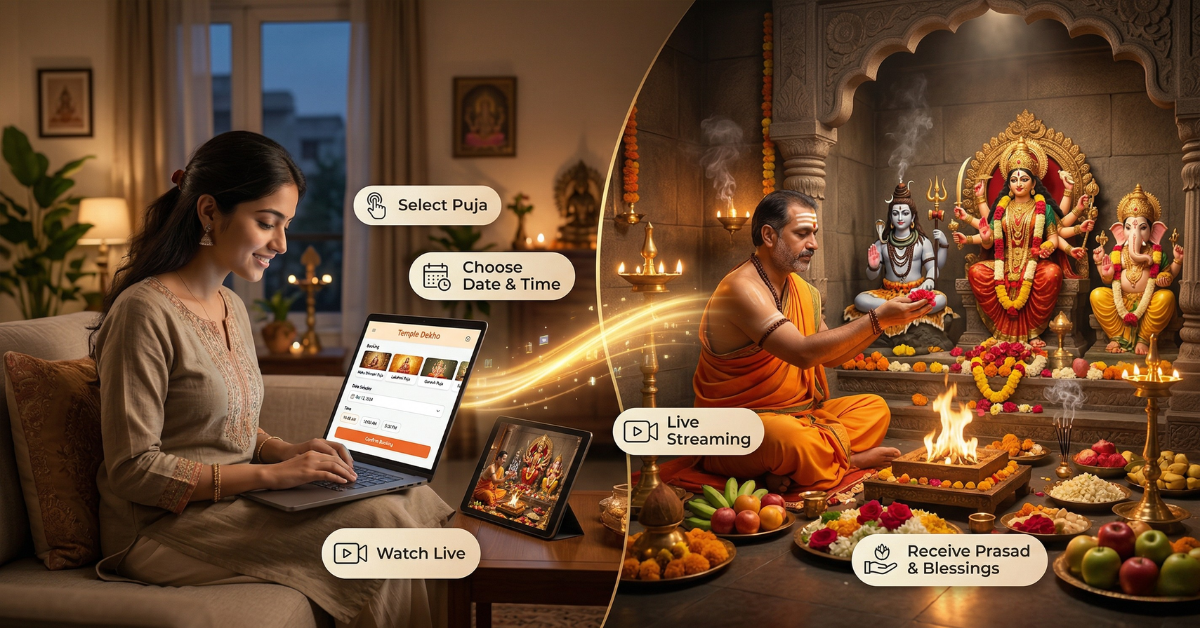
Step 1: Select Your Puja
Visit Temple Dekho and choose the puja that matches your intention. The platform covers the full range including Griha Pravesh, Satyanarayan Katha, Rudrabhishek, Namkaran, ancestral rites and festival-specific ceremonies. If unsure which ritual fits your need, the platform’s guidance helps clarify.
Step 2: Select a Package and Date
Choose a puja package based on how many devotees. Then select a date using Temple Dekho’s Panchang-based Muhurat recommendations to ensure the ritual falls in a genuinely auspicious window.
Step 3: Provide Your Details
Enter your full name,phone number, gotram (family lineage) and the specific sankalpa or intention for the puja. These are not administrative formalities. They are what the pandit needs to formally incorporate you into the ceremony at the sankalpa stage.
Step 4: Confirm and Pay
Complete the booking through the platform’s secure payment process. A confirmation with your ceremony details is sent immediately after.
Step 5: Join the Live Ceremony
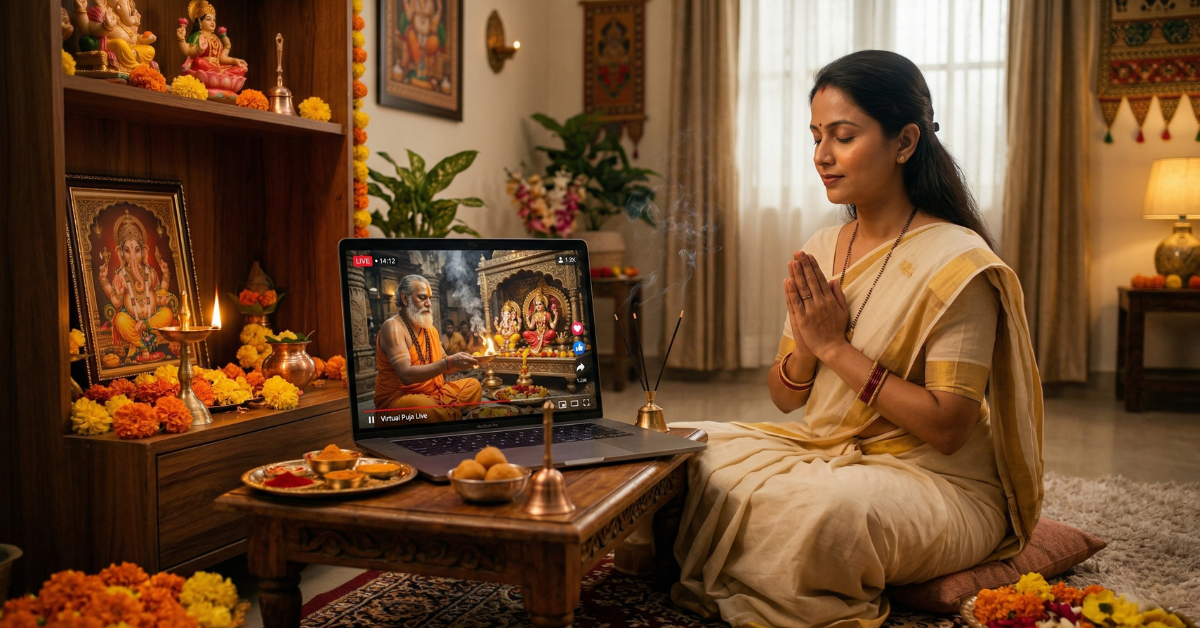
On the day of the puja, join the live stream a few minutes early. Light a small lamp or incense at your location if possible. Follow along as the pandit performs the ritual, confirm your intention at the sankalpa stage, offer prayers during the aarti and receive the closing blessings.
The most important preparation is not physical. A clean, quiet space and a focused, respectful mindset are what make the ritual genuinely meaningful rather than merely observed.
Is an Online Puja as Spiritually Valid as an In-Person One?
This question deserves a direct answer because it is the one that sits beneath every other concern about e puja India.
The skeptic’s argument is that physical presence at a ritual carries an irreplaceable quality, an immersive, multisensory experience that a screen cannot replicate. This is true as an experiential observation. A live, in-person ceremony at a major temple in India is an extraordinary thing to be part of.
But spiritual validity and experiential richness are two different things. The Vedic tradition is unambiguous about where a ritual’s power resides: in the pandit’s qualifications, the correct performance of prescribed procedures and the sincerity of the devotee’s sankalpa. All three are fully present in a properly conducted online puja.
The tradition of proxy rituals, performing ceremonies on behalf of absent devotees, is not a modern accommodation. It predates technology by centuries. Families have always had rituals performed at Kashi or Prayagraj or Tirupati on behalf of members who could not be there. What Temple Dekho offers is the same principle extended and made accessible to a global community through live-streaming technology that allows the devotee to be present in real time rather than simply represented.
The divine has never required a passport. Sincere devotion, properly guided by qualified ritual expertise, has always been sufficient.
Conclusion
The Indian diaspora’s turn toward online puja services is not a story about technology replacing tradition. It is a story about tradition proving, once again, that it is resilient enough to survive and thrive in any environment it encounters.
Devotion has never been confined by geography. The Bhagavad Gita established that truth thousands of years before the internet existed. What online puja services India, virtual puja for NRIs and e puja India have done is make that truth practically accessible to millions of people who needed exactly this: a reliable, authentic, spiritually meaningful way to honor their faith, celebrate their milestones and hand a living tradition to the generation growing up far from the land it came from.
Where there is sincere devotion, the divine is never far. Technology has simply made that truth more accessible than ever before.
Ready to book your next puja from wherever you are? Visit Temple Dekho, choose your ceremony, select an auspicious Muhurat and let a verified pandit perform the ritual on your behalf, sincerely, authentically and in your name.
Frequently Asked Questions
1. Are online puja services spiritually valid without physical presence?
Yes. Spiritual validity rests on three foundations: the pandit's qualifications, correct Vedic procedures and the sincerity of the devotee's sankalpa. None require physical presence. Proxy rituals performed on behalf of absent devotees are a centuries-old Vedic practice. Temple Dekho ensures every pandit is verified and every devotee's name, gotra and intention are formally incorporated at the sankalpa stage.
2. What types of online puja are available for NRIs?
The most frequently booked rituals include Satyanarayan Puja for gratitude and prosperity, Griha Pravesh for housewarming blessings, Namkaran for naming ceremonies, Rudrabhishek for Shiva worship and protection and Pitru Tarpan for ancestral rites. Festival-specific pujas during Navratri, Diwali and Janmashtami also see significant demand from the global Hindu community.
3. How do I know the pandit follows authentic Vedic procedures?
Temple Dekho verifies all pandits for Vedic ritual knowledge, correct Sanskrit pronunciation and ceremony-specific requirements. Devotees can also communicate specific family traditions or regional customs at booking to ensure the ceremony reflects their personal background accurately.
4. Can I receive prasad from an online puja if I live abroad?
Temple Dekho offers prasad delivery where available. For locations where physical delivery is not currently available, the pandit performs the prasad blessing during the live ceremony and devotees participate in real time through the live stream. Preparing a simple local offering at your end to offer in synchrony with the ceremony is also encouraged.
5. How do I choose an auspicious time from a different time zone?
Temple Dekho provides Panchang-based Muhurat recommendations for every ritual type, calculated in Indian Standard Time and coordinated across international time zones. For major rituals like Griha Pravesh or Vivah Muhurat, providing birth details at booking allows for personalized Muhurat calculation specific to your Nakshatra and family horoscope.
Share On
Please install and activate TablePress plugin to work this widget.